

In Shooting Nails Or Drive Pins, nails such as cement nails, small screws, corrugated paper nails, fiberboard nails, insulation nails, and bolts require hot-dip galvanizing. In daily life, hot-dip galvanizing these nails extends their service life and improves their corrosion resistance. Let's learn about the hot-dip galvanizing process for nails.
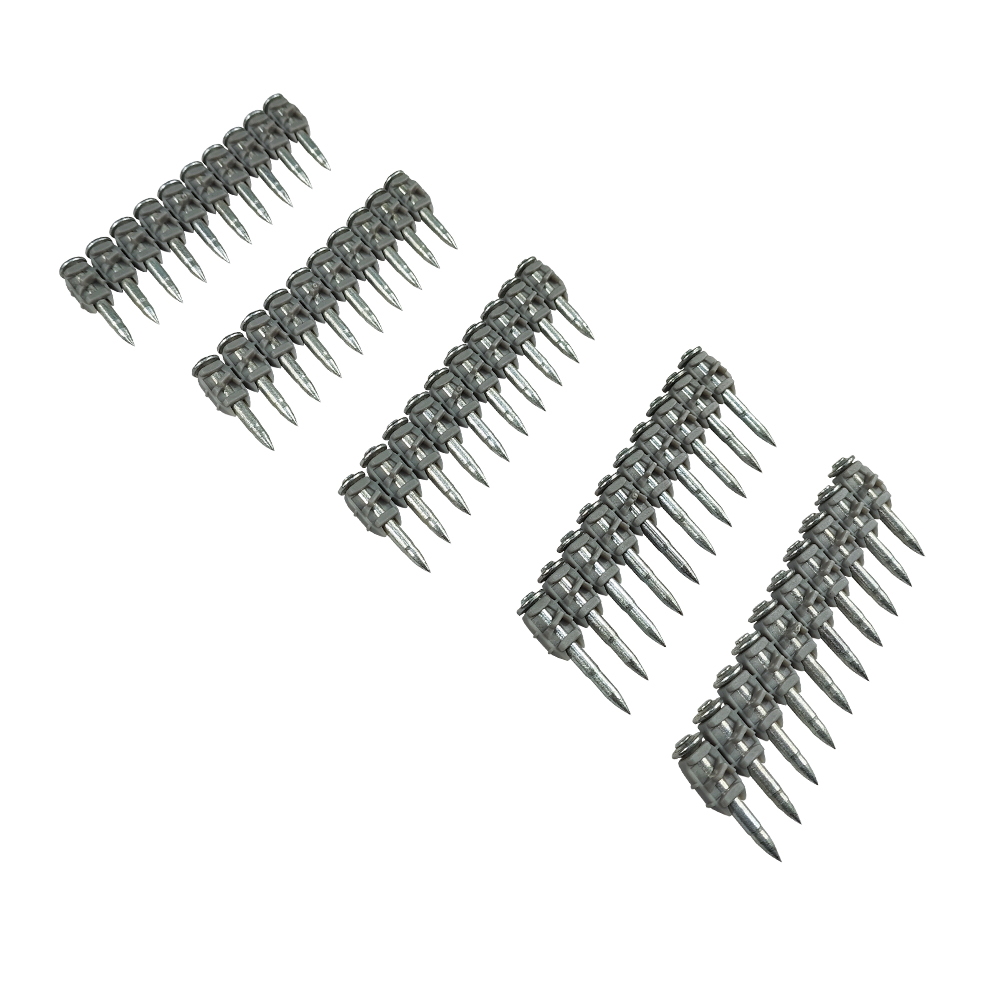
Hot-dip galvanizing methods can be divided into two categories: electroplating and hot-dip galvanizing. Compared to electroplating, hot-dip galvanizing allows zinc to be better coated on various types of nails, resulting in a smooth surface and uniform zinc coverage.
Furthermore, the zinc plated is purer, ensuring excellent corrosion resistance. The practical effect is very good. Hot-dip galvanizing combines ferrous ions and zinc ions, making them firmly bonded together. The surface of the nail is not just zinc; it's a compound of steel and zinc.
The characteristics of electroplating and hot-dip galvanizing processes are as follows: During standard indoor temperature production operations, the coating formation is not an electrodeposition process, but rather occurs through the rotation of the plating drum, causing the materials within the drum to collide and transfer energy, thus forming the coating.
The coating structure consists of granular spherical zinc powder deformed by impact and force, transforming into flattened, disc-shaped zinc particles that accumulate and solidify into a coating layer.
This type of coating possesses the basic physical characteristics of metallic zinc, and its function is to provide an anodizing protective coating with rust-preventing properties for iron-based components.